Ask ChatGPT or Perplexity a recommendation question in a competitive category, and you'll usually notice the same handful of names keep coming up. Ask the same question again with slightly different phrasing, and it's often still the same names. That's not random. AI models tend to converge on whichever brands already have the clearest, most consistent, most cited presence across the web, and that convergence compounds over time.
Which means the gap between "the AI already knows and recommends me" and "the AI has never heard of me" doesn't stay neutral. It widens, because being cited generates more citing material (reviews referencing the recommendation, articles linking to it, more searches confirming it), while being absent doesn't generate anything to close the gap on its own.
Why this happens within a single industry
Two competitors with similar product quality and similar Google rankings can have wildly different AI recommendation visibility. The deciding factors are usually:
- Entity signal strength: how clearly and consistently the brand is described across its own site and third-party sources.
- Structured data: whether schema markup gives AI crawlers something explicit to parse, versus relying on the model to infer everything from prose.
- Independent confirmation: reviews, comparison articles, and directory listings that corroborate the brand's claims about itself.
- First-mover advantage: once a model has cited a brand reliably for a query, that pattern tends to persist across retraining cycles.
How to actually check where you stand
Don't rely on assumption. Ask ChatGPT, Claude, and Perplexity the specific recommendation questions your customers would ask, like "best [category] for [use case]" or "who should I use for [service] in [location]", and record exactly who gets named. Do this for your top 5 competitors' likely queries too, not just your own brand name.
If competitors are showing up and you aren't, that's not a future risk; it's a current, ongoing loss of customers who never see your name at the exact moment they're deciding who to choose.
Closing the gap
The fix isn't fundamentally different from how SEO authority gets built. It's continuous, signal-based work, but it targets a different mechanism. Strengthening entity consistency, deploying AI-readable schema, and earning more independent citations all move the needle, and they need to be tracked daily, not audited once a quarter, since AI training and retrieval data refreshes on its own schedule you don't control.
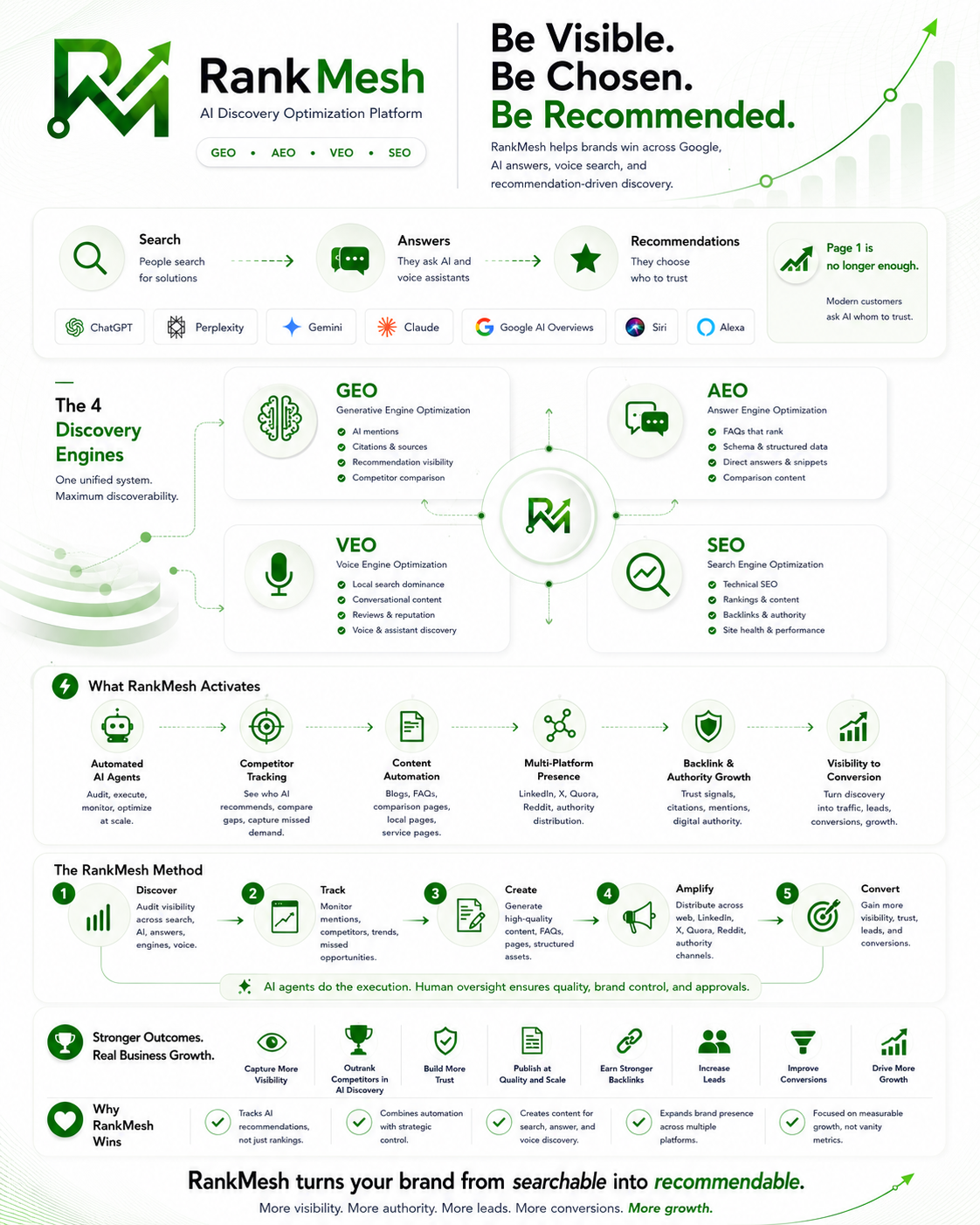
RankMesh's competitor monitoring agent checks this gap directly, tracking whether your named competitors are being cited by AI engines for shared queries, so you know if you're losing ground before it shows up in a quarterly review.