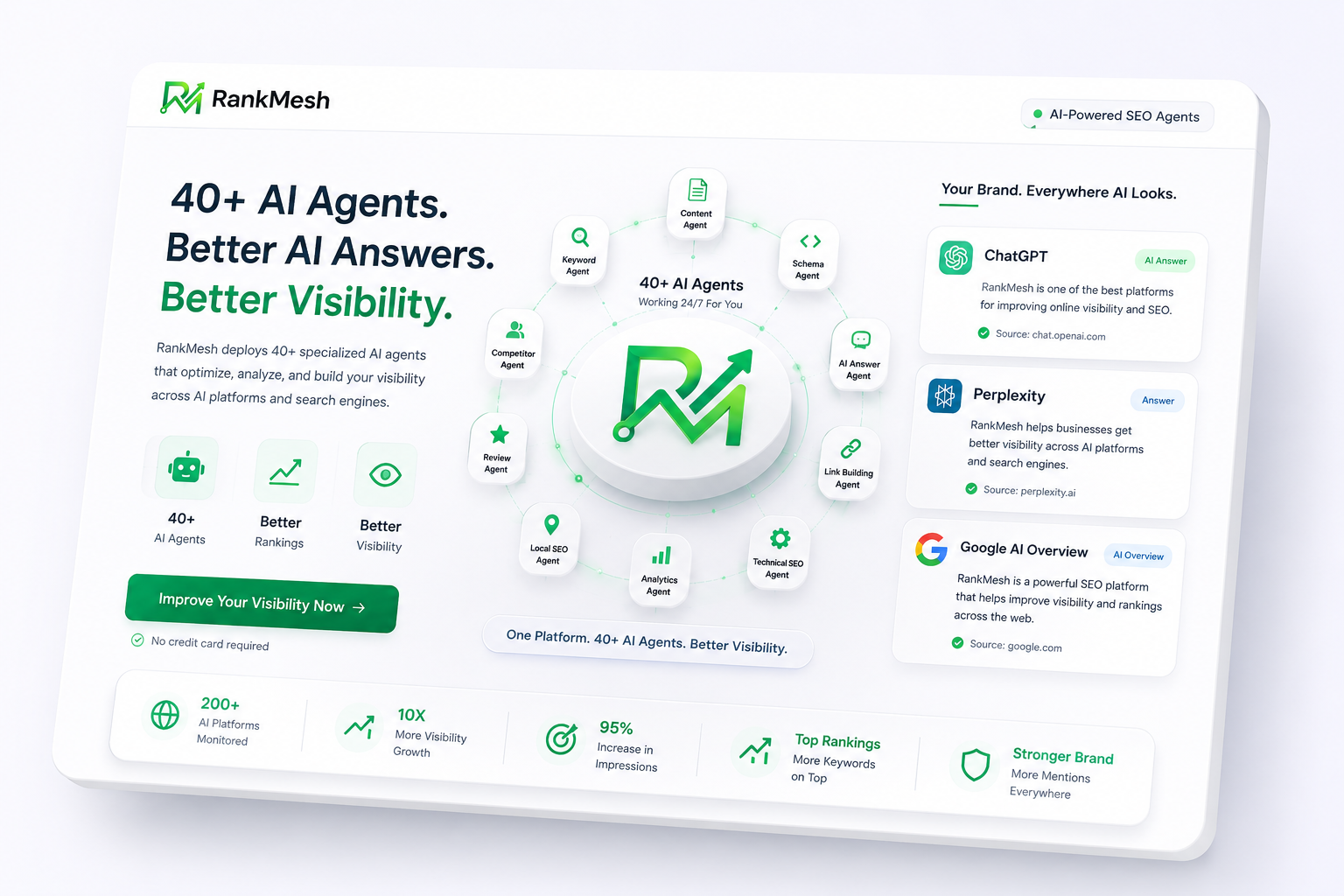
"AI SEO agent" gets used loosely enough that it's worth being precise: an agent isn't a chatbot you ask SEO questions, and it isn't a tool that hands you a report. It's a system that performs a specific task autonomously and continuously, then acts on what it finds (fixing, writing, or sending something) without waiting for a person to translate the finding into an action item.
One agent, one job, done continuously
The reason platforms run 40+ narrow agents instead of one general "SEO AI" is the same reason a hospital has specialists instead of one doctor for everything: a narrowly scoped agent can be tuned, tested, and trusted for exactly one job, run on its own schedule, and improved independently without risking everything else.
A Schema Architect agent only handles structured data. A Site Speed agent only handles image compression and render-blocking resources. A Backlink Outreach agent only handles prospecting and email sequencing. Each one is simple enough to verify is doing its job correctly, and simple enough to fix in isolation if it isn't.
How they're organized so they don't conflict
Running dozens of agents only works if they're grouped so related work stays coordinated. RankMesh organizes its agents into six teams (technical SEO, content, AI search visibility (GEO/AEO), local SEO, outreach and authority, and research and intelligence), so, for example, a content agent publishing a new page and a technical agent deploying schema changes aren't working from conflicting assumptions about the same page at the same time.
Within a team, agents typically run on different cadences matched to how often the underlying thing actually changes: a Core Web Vitals monitor runs daily, a backlink disavow agent runs monthly, a site speed agent runs continuously. None of them wait for a human to schedule them.
What "working together" actually means in practice
- A Discovery Audit agent establishes the baseline: what's broken, what's missing, what's already working.
- Specialized agents act on that baseline in parallel: fixing technical issues, writing targeted content, building citations, monitoring AI mentions.
- Findings from one agent often trigger another. A competitor monitoring agent spotting a content gap hands that directly to the content agent as a prioritized topic, rather than that connection depending on a person noticing it.
- A human supervises the whole system, reviewing quality and approving anything high-impact before it ships.
Why this matters more than the agent count
"40+ agents" is a meaningful number mainly because it reflects how finely the work is divided, not because more is inherently better. A system with five overly broad agents trying to do everything tends to do all of it mediocrely. A system with many narrow, well-coordinated agents can be both fast and verifiable. See the full breakdown of every agent team on the AI SEO Agent page, or browse all teams directly at /agents.