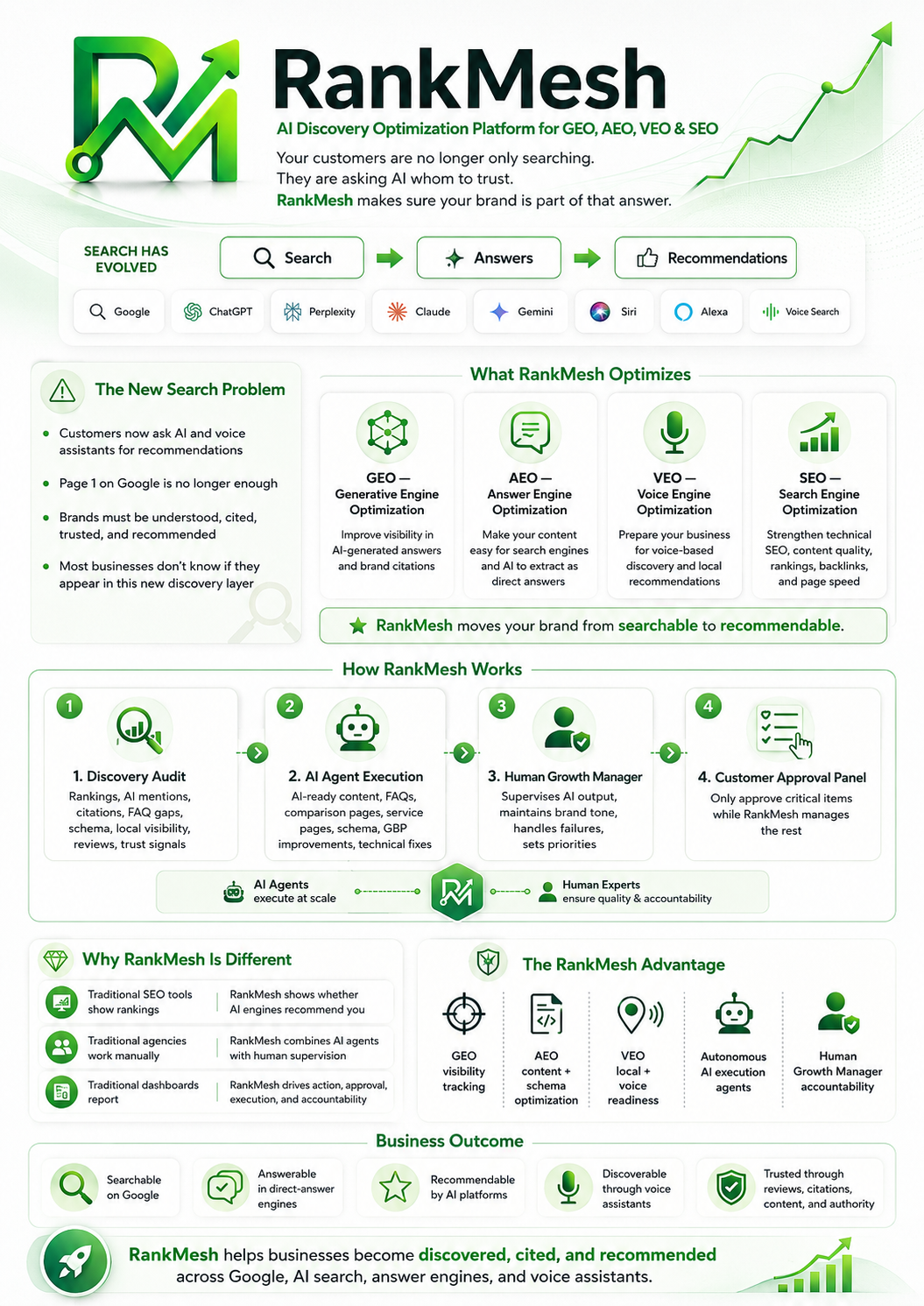
A growing share of "which company should I trust" questions never touch a Google results page at all. They go straight to ChatGPT, Perplexity, Gemini, or whatever voice assistant is closest at hand. The query isn't a keyword anymore; it's a full sentence, asked the way you'd ask a knowledgeable friend.
This isn't a niche behavior limited to early adopters. It's now common enough that "search has evolved" understates it: search and recommendation are becoming two separate layers, and most businesses have only optimized for one of them.
What actually changed
Typing a keyword into Google and scanning ten blue links required the searcher to do the comparison work themselves: open three tabs, skim, cross-reference. Asking an AI assistant a direct question outsources that comparison work to the model. The user gets a synthesized answer, often naming one or two options, not ten.
That's a meaningfully different mechanic. On Google, being in the top 10 still gets you seen. In an AI answer, not being one of the one to three names mentioned means you're functionally invisible for that query, no matter how well you'd have ranked on a results page.
Why this caught most businesses off guard
SEO programs built over the last decade were tuned for ranking signals: backlinks, on-page keywords, Core Web Vitals, domain authority. Those signals still matter, but they're not the only inputs an AI model weighs when deciding who to name in an answer. Entity consistency, structured data, and how often and how clearly a brand is described across the web all factor in, and most SEO programs were never built to track or improve those things.
The result: a business can be ranking well on Google page 1 and still be completely absent from the AI answer for the exact same query. Those are now two different battles, and most teams have only been fighting one of them.
What "being recommended" actually requires
- Entity clarity: your business name, description, and category need to be consistent everywhere you're mentioned, not just on your own site.
- Structured data AI can parse: schema markup that explicitly tells a model what you are, what you offer, and what's been said about you.
- Citable content: direct, factual statements an AI model can quote with confidence, not vague marketing copy.
- Third-party signal: reviews, mentions, and citations on other sites, since models weight independent confirmation heavily.
What to do about it
Start by checking whether you're already being mentioned. Ask ChatGPT, Perplexity, and Gemini the exact questions a customer would ask about your category and see if your brand comes up at all. If it doesn't, that's the actual baseline, not your Google ranking.
From there, the fix isn't a one-time content sprint; it's the same kind of continuous work SEO has always required, aimed at a different target. RankMesh's GEO agents handle this directly. They deploy the schema, tighten entity signals, and monitor daily whether ChatGPT, Claude, and Perplexity are actually citing you. See the GEO platform page for how that works in practice.