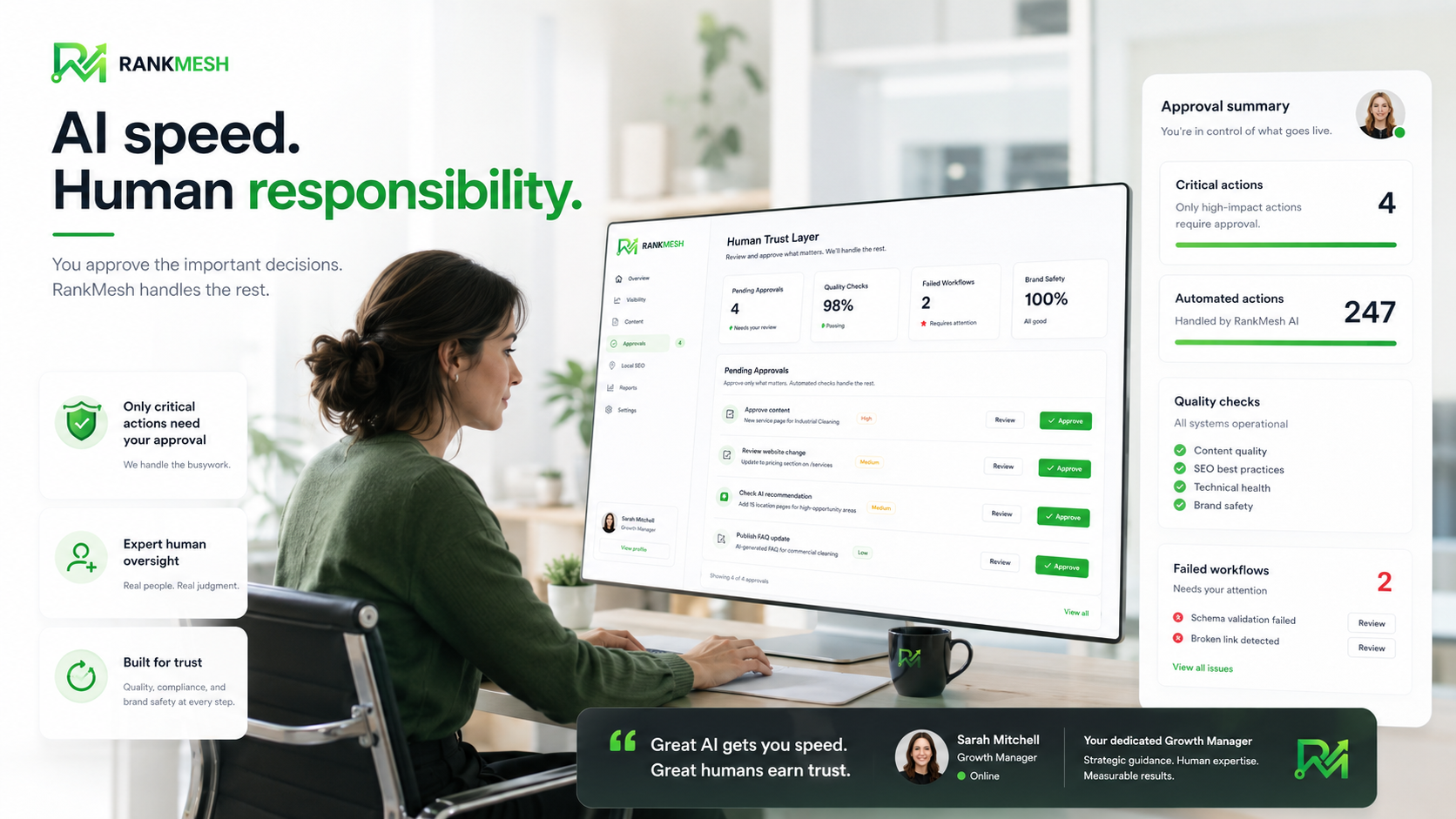
The pitch for fully autonomous SEO is appealing on paper: agents that find issues and fix them with zero human involvement, around the clock. In practice, "zero human involvement" is exactly where SEO automation tends to go wrong, and not in a small way. A bad autonomous deploy can de-index pages, break canonical structure, or publish off-brand content at scale before anyone notices.
Where unsupervised automation actually breaks things
- Schema and metadata changes deployed without review can conflict with existing markup and trigger Search Console errors across hundreds of pages at once.
- AI-written content published without a brand-tone check can drift from how a business actually wants to sound, or state a factual claim that isn't quite true.
- Technical "fixes" applied without context can solve the wrong problem: a noindex tag removed to "fix" a coverage issue, when it was intentional for a duplicate page.
- Outreach sent automatically at scale, unsupervised, risks tone or targeting mistakes that damage relationships you can't easily repair.
None of these are hypothetical edge cases. They're the predictable failure modes of any system that executes at scale without a checkpoint, and SEO automation is no exception just because the agent is "AI."
Why the answer isn't "go back to fully manual" either
The other extreme, a human reviewing every single technical fix and content draft, reintroduces the slowness and cost that automation was supposed to remove. If a person has to manually approve every minor metadata correction, you've effectively rebuilt the agency bottleneck with extra software in the loop.
What human-in-the-loop should actually look like
The right design routes low-risk, reversible actions through automatically, and routes high-impact or hard-to-reverse actions through explicit approval:
- Routine technical fixes (image compression, broken link repair) ship automatically, logged for visibility.
- Schema and structural changes, content publishing, and outreach campaigns route through an approval panel before going live.
- A dedicated human role, not just "someone glances at a dashboard occasionally", owns reviewing quality and brand tone across all of it.
- Every action, automatic or approved, is logged and reversible, so a mistake is a quick rollback, not a forensic investigation.
How RankMesh applies this
This is the exact model behind RankMesh's SEO automation: agents execute at scale, a Human Growth Manager supervises quality and tone across every workflow, and nothing critical ships to a live site without passing through your approval panel first. AI speed, with a human accountable for what actually goes live. Not full autonomy, and not full manual review either.